
"Goats on the Rock"

I have the honor of being featured artist for the month of July at Orcas Island Artworks. I wanted to make a special piece just for the occasion. In May (a little too close to the deadline if you ask me) I had the realization that the time had come to create a piece I'd been incubating in my head for years. Here's the story behind it and a little bit of how it got made.
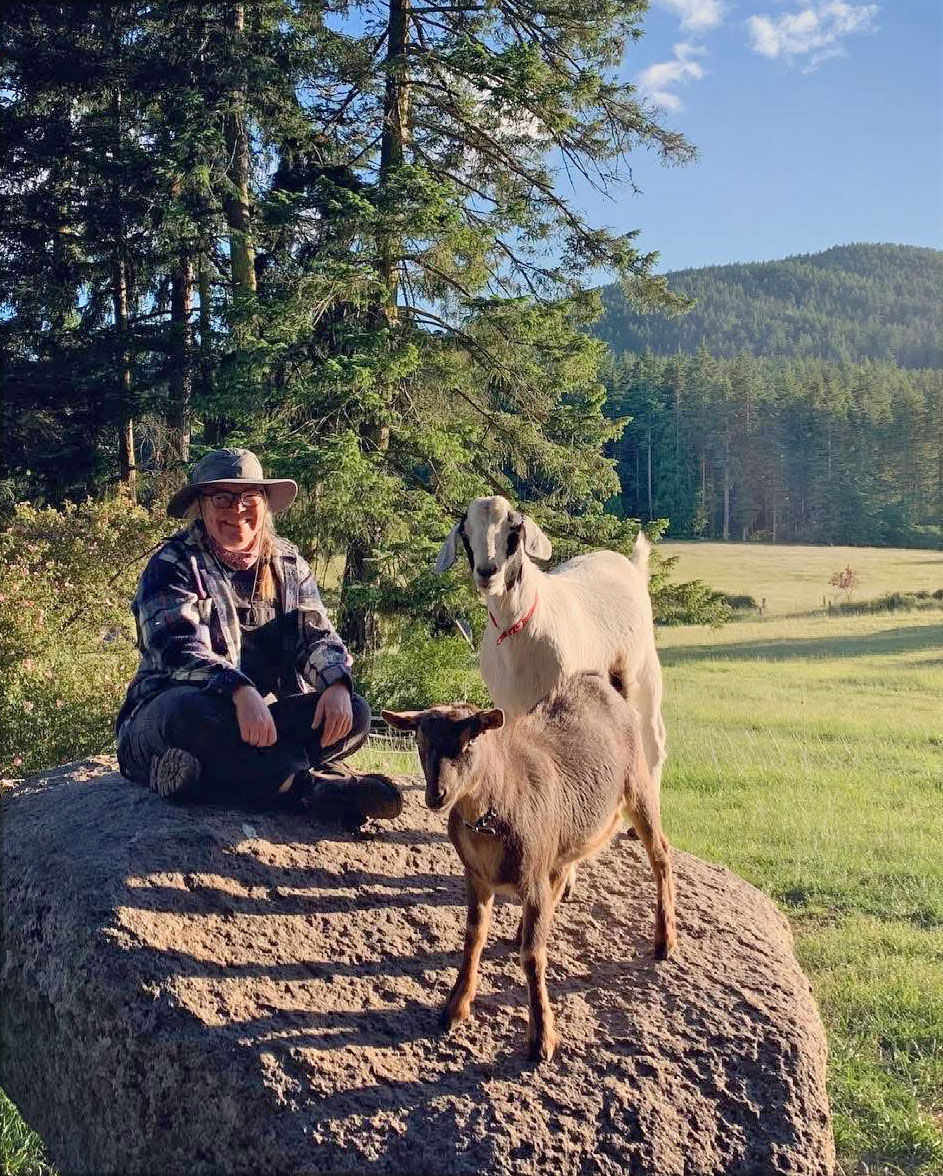
Like goats, I love a good rock. I'm not a rock climber -- but there is something about a well-placed boulder that taps into my 10-year-old self and makes me want to scramble to the top and enjoy the view. If it's baked by the sun, then I tap into. my inner lizard and could just lay there all day.
At Lum Farm, there is a trio of large rocks that are the favorites of the resident goats. It's a play gym, a sunny napping spot, and a way to get a better view of the lay of the land.


Throughout the seasons, I amassed a collection of photos of the goats having fun on these rocks, knowing that some day I would work on a large painting of them. As I pondered what to create for the Featured Artist wall, I realized the time had come. I call it "Goats on the rock" not just because I'm literal, but also as a nod to the affectionate nickname locals call Orcas Island. It's another little love letter to island agriculture.
The painting is exhibited at Orcas Island Artworks through July, and I'd like to share some of the process of how I made it.

In a nutshell, the above photos represent the different phases of working on the piece: I compose a line drawing, needle and wet-felt an underpainting, and then layer on the color and fuss the design. Here's the process in a little more depth:

For the composition of my more involved paintings, I put on my Photoshop Nerd hat and played around with design, roughing in which goats I wanted where. The above photo was my final cut. With the original photos, I removed a couple goats from the top of the rock to clean up the lines, and added a couple at the bottom to create a sort of half-moon of goats.

The next phase is to transfer the drawing. For smaller paintings, I often just freehand, but these large paintings with detailed elements call for a little extra help. I use a large piece of natural pre-felt as my background, and using the grid method and a sharpie I map out the general lay of the land.
For the animals, when I need to be more exact, I transfer my drawing onto water soluble stabilizer. It is adhesive on the back, and meant for stabilizing fabric for embroidery projects. It's not my favorite because of the tactile feeling of punching the felting needle through the film, but it is an invaluable tool.

Once the drawing is transferred, I felt on the initial underpainting using a monotone pallette for certain elements. This is to make sure I've got the image on there solidly., and also creates lovely warm undertones in the final piece. (For my www.livingfelt.com friends: I used mostly MC-1 Wool for the goats, and then the background scenery and rock were in Short Fiber Merino so that it would blend nicely at the wet-felting stage).

Once the goats were in, It was time to address the background. I was actually quite intimidated by the rock -- It had so much texture and color, yet I didn't want it to overshadow the goats. It was going to be a lesson in layering color for depth, shadow, and texture.
Once the entire "canvas" was covered, I lightly wet-felted the piece. I forgot to take photos of this process... but it involved bubble-wrap, soapy water and a pool noodle! Enjoy the visualization! I like to wet felt the piece partway through because it evens out the textures that occur in working with so many layers of different types of wool. I also take the opportunity to soak out all that fabric stabilizer so I don't have to deal with it anymore. I don't wet felt the piece at the end because you lose some of the crispness and detail.

This is the piece after wet felting. It looks almost finished, but actually needs many many more hours of layering and detail. As I was making this piece I had a lovely milestone of moving my worktable into a new studio space -- a renovated 1880's log cabin on a neighboring farm. I feel like the ambiance and history of the space just soaks right into the wool, and I couldn't be more thrilled.

When I finish a piece I usually like to hang it up and stare at it for a number of days. I didn't afford myself enough time for this one, but did stare at it long enough that I realized I wanted to add a couple goat friends off in the distance.
Something I ask myself throughout the work is "how can I add to the story?" I want my paintings to invoke a narrative for each viewer. I realize that this story will be different for each person, so I can at least offer as many plot elements as possible. Pondering this as I work fuels everything from what time of day and season the painting captures, to the expressions on the goats' faces, to what little things are happening in the background. In my own narrative these little guys in the distance want to soak in the sun but need a little space from the antics (shout out to the introverts in every flock!)
At this pint, it was July 1. So, it was off to my friend George's for a beautifully hand-crafted frame, and I installed "Goats on the Rock" at Orcas Artworks on July 2nd - only one day late! I also afforded time for an off island trip to "How It Works" in Anacortes to get it scanned. That means that I will soon have prints and cards of this image. The first print of this one is going to hang on my own wall! If you would like to order a print for yourself, please reach out to me.

Below is one of my favorite rock moments -- Bean is a very playful and people-oriented goat (you can find her at the very top of the painting), and she and I were hamming it up. Amy Lum snapped this photo unbeknownst to me. It was New Years 2021. I believe Bean and I were singing "We are the Champions" very loudly because we had survived 2020. Oh, our sweet naivité -- little did we know what the coming years would bring. That said, among your coping tools, i recommend goats, humor and a solid foundation.

Links:
How it Works art scanning and reproduction in Anacortes
Comments